See our latest brochure that we're distributing to Lanikai residents in early 2026.
Origins of the Coconut Rhinoceros Beetle in Hawaii
The Coconut Rhinoceros Beetle (CRB) is native to Southeast Asia, particularly India, Indonesia, and the Philippines, and has been spreading across the Pacific for more than a century. It was first recorded in Samoa in 1909, then continued island-hopping, reaching Guam in 2003 where it became firmly established, and arriving in Hawaii in December 2013 with the initial detection at Joint Base Pearl Harbor/Hickam on Oahu.
In Guam, the CRB population underwent genetic divergence that produced a distinct version of CRB called CRB-G, and this is the version of CRB that is in Hawaii now. CRB-G has nearly complete resistance to the virus (Oryctes rhinoceros nudivirus) that has been used to control CRB in other parts of the Pacific for the past 30 years.
CRB is now rampant on Kauai and Oahu. The State and others are attempting, with some success, to prevent its establishment on Maui, Big Island, Molokai, and Lanai.
On Oahu, CRB has devastated palms in central Oahu, the Waianae Coast, the North Shore, Waimanaolo, and has been marching down the Windward Coast. It is present in Kailua and now Lanikai.
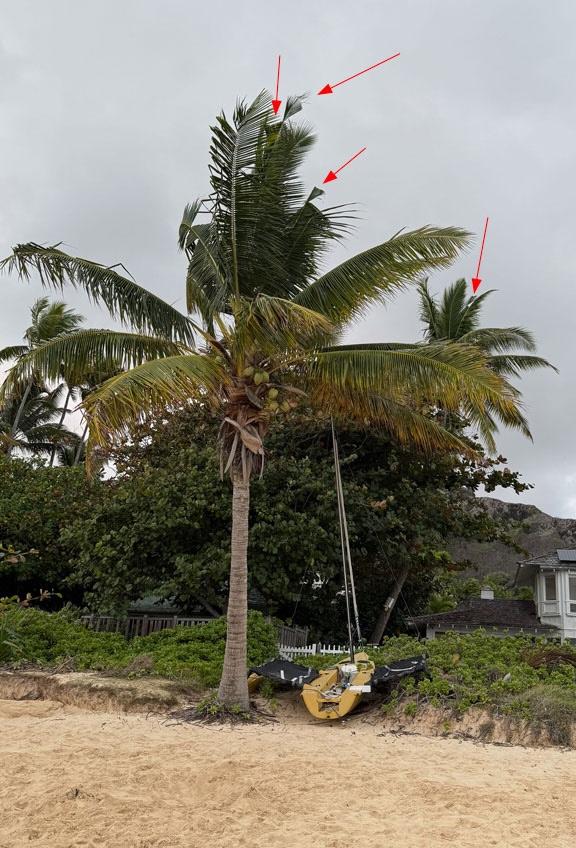
Progressive Damage from CRB
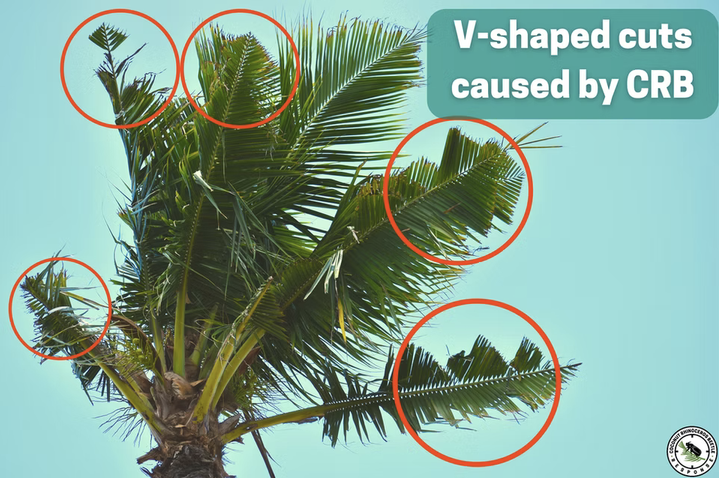
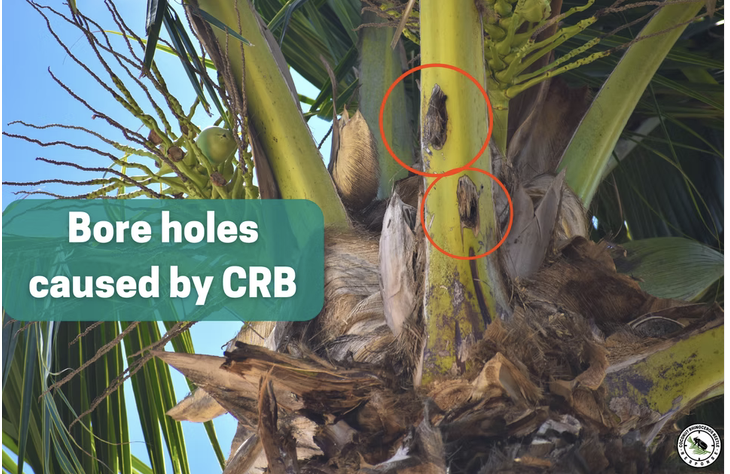
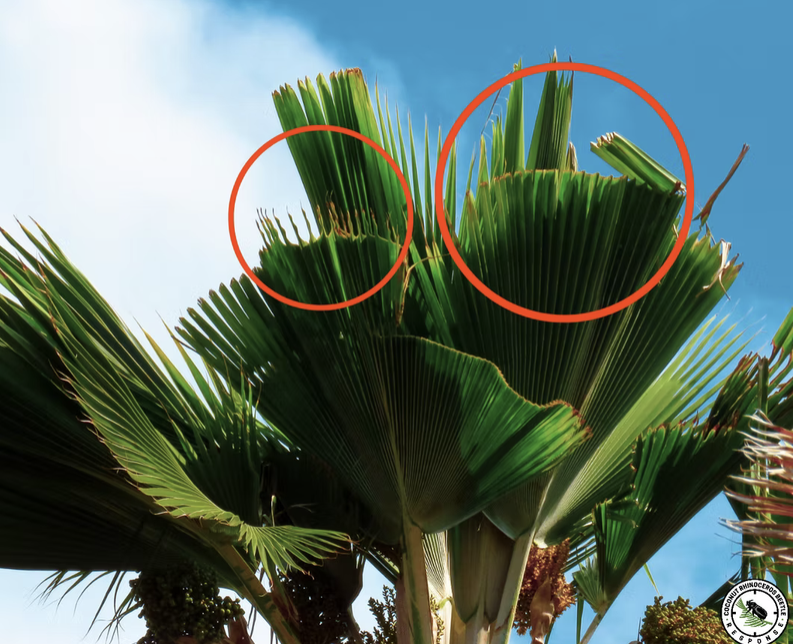
When CRB first invade a palm tree, there is usually little evidence. CRB are active at night, and fly or crawl up the trunks of palm trees. Once in the crown, they use their rhinoceros horn to bore into the heart of the palm (where all the fronds meet) and feed on the heart of the palm. Months later, fronds emerge that were inside the tree when the CRB was feeding. Some of these fronds display a characteristic "cut" or "V-cut" which looks like someone cut across the frond with a scissors.
These frond cuts are in evidence on almost every block of the Lanikai loop as of January 2026. This indicates an active and growing CRB population. Note that in July of 2025, no trees displayed frond cuts that we know of.
Tree trimmers who have worked the North Shore, Kahana, Central Oahu will tell you that trees in this state usually get worse and die.
Personal experience from some of these tree trimmers also indicates that if a palm has some damage, and then protective measures are applied (wax cups, bowtie nets), that the palms can recover. Once you exclude the CRB from the crown, the heart of the palm is no longer being eaten by nightly visits from CRB.
How to identify CRB (info and pix courtesy of CRBhawaii.org)

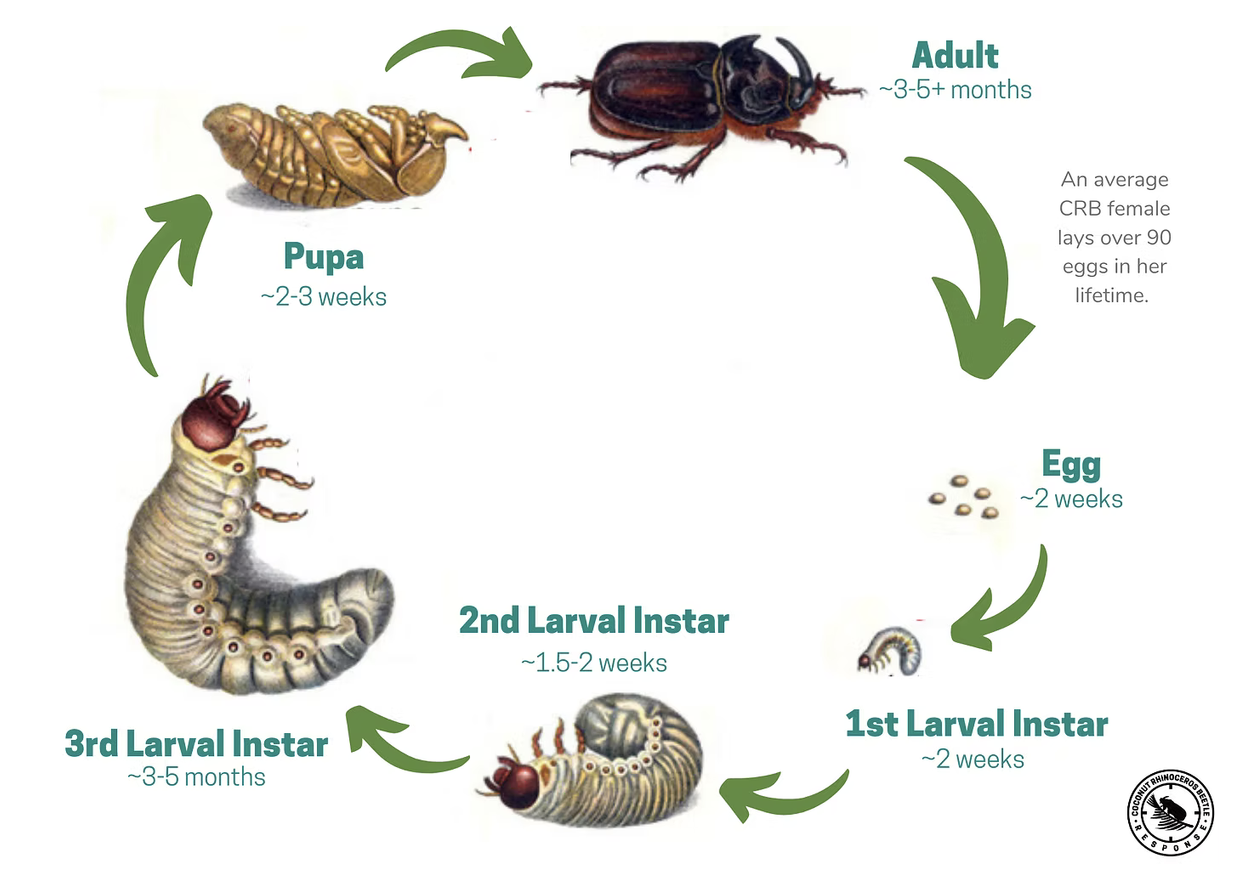
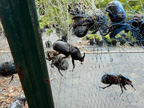
Adult coconut rhinoceros beetle (CRB) are black beetles averaging 2 inches in length with a visible horn. They are night-active and can fly.
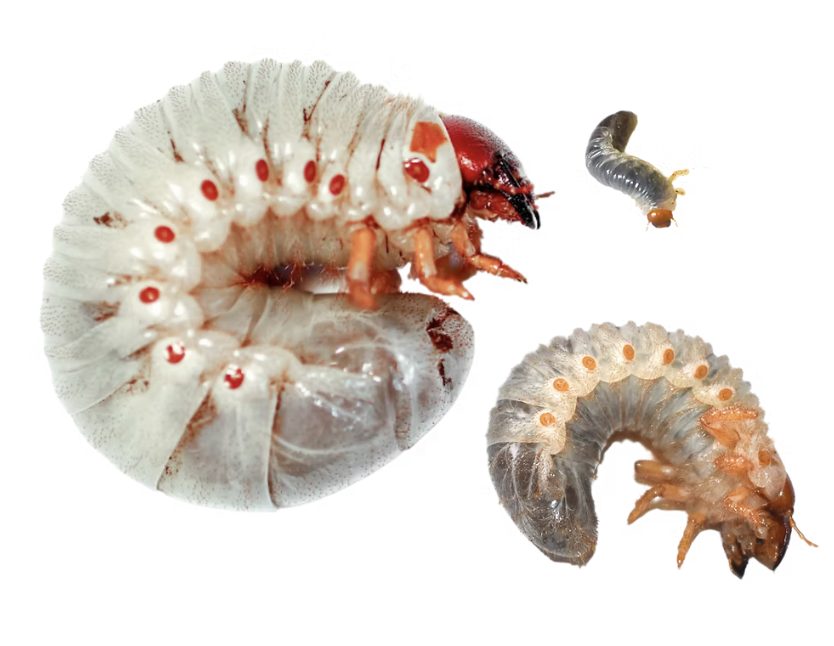
CRB larvae can grow up to three inches before pupating. These larvae crawl on their side and curl into a "C" shape when handled. As larvae, they live and feed on decomposing plant material. CRB prefer coconut palm green waste but can survive in most decaying plant material.
What Early CRB Damage Looks Like
CRB feed on and damage coconut, royal, date, and fan palms. If these preferred food sources are unavailable, CRB can shift to feed on other palms and tropical crops. CRB use their front legs and horn to dig into the crown of trees. Then, they use their sucking mouthparts to feed on the juices in the inner spear.

How to Determine Where CRB Is
To determine if CRB are in an area requires deploying simple, cheap pheromone traps, of which there are many designs. These traps attract CRB by three different mechanisms: CRB pheromones; Light, including UV; Bait in the form of pieces of coconut tree and/or mulch
Here are four short videos from the University of Guam that show how to make different types of pheromone traps:
Here are some additional links on building pheromone traps:
- SaveHawaiianPalms.com has excellent info on building CRB traps.
- Pheromone trap made out of water bottles from Grenada in the Caribbean.
Here is a local source selling pre-made pheromone traps:
- ProAct Products using pheromone plus a solar-powered UV light.
Here is where you can buy CRB pheromone lure packets. The pheromone packets last about 30 days and then need to be renewed. The active chemical is Ethyl-4-methyloctanoate.
- CRB Lure from Evergreen Growers Supply
- HEDO Pheromone Lure on Amazon
- Contemporary Landscaping in Waimanalo sells the same pheromone lure packets as Evergreen.
Educational Resources
- CRBHawaii.org is the website of the State's "CRB Response" and has great general information on CRB in Hawaii (some reproduced here). It is funded through grants from UH, USDA, and DLNR. CRB Response is focusing largely on preventing the spread of CRB to neighbor islands. On Kauai and Oahu, where CRB is rampant, CRB Response has given up on eradication and are more into "containment" meaning preventing the spread to other islands.
- Hawaii Invasive Species CRB 2025 Control Methods outlines the latest chemical and Biocontrol methods for containing CRB.
- 12 Years In: How Hawaii is Still Working to Curb the Coconut Rhinoceros Beetle 18Jun25
- Hawai‘i Explores Natural Approaches to Address Coconut Rhinoceros Beetle 3Dec25
- CRB Management Options for Landscape and Nurseries in Hawaii From hawaiiscape.com 15Dec23
- Preliminary Trials on Use of Essential Oils for IPM of Coconut Rhinoceros Beetle UH Department of Tropical Plant and Soil Sciences, December 2023
- SaveHawaiianPalms.com Excellent info on building your own ring spray systems and CRB traps. Also good discussions of netting and essential oils for repelling CRB.
- Dozens of CRB larvae discovered in garden soil sold at Oahu store August 2024 and it was Miracle Grow that he got at the Navy Exchange!
- Netting for Physical IPM of Coconut Rhinoceros Beetle From UH Department of Tropical Plant and Soil Sciences. Good info and covers netting mulch piles as well.
Photo & Video Gallery
Click anywhere to close
Click anywhere to close