How to Protect Your Lanikai Palms
If you can protect your trees from CRB, you can prevent them from being eaten and then dying. And you can protect your trees by making them "stinky" and unpallatable to CRB, and by physically protecting your trees, as with nets.
The "State of the Art" in protecting Lanikai palms is currently (early 2026) applying essential-oil laden wax ("frond inserts") to the crown as well as applying bowtie nets. Both of these are inserted into the crevices where the fronds meet the trunk of the tree, and is where most CRB enter the heart of the palm. The soft wax comes in cups and it's sqeezed out and into the crevice by the tree trimmer, then smushed down. The wax allows the essential oil to last for many months instead of evaporating in a week or two.
The "Save Lanikai" program is making both wax cups and bowtie nets available for free to Lanikai residents only. Residents then would give these protective measure to their tree trimmers who would them apply them in the crowns. The wax should be replaced at each trimming. The bowtie nets can often be reused: the tree trimmer moves the nets up from the fronds he's cutting off to fronds that are newly emerging higher up.
Essential Oil Wax Frond Inserts
Research in Hawaii has shown that certain essential oils repel and can kill CRB. When applied to the crowns of trees, these oils (as well as regular insecticides) repel CRB. The problem is that both oils and insecticides degrade and evaporate rapidly so they have to be re-applied every week or two to provide continuing protection. Thus the development of "frond inserts", which are materials that can hold essential oils (or insecticides) and emit them slowly over a period of months, and which are placed in the crevices between fronds and tree trunk where CRB normally enter the crown. Many materials have been tried (waxed rope segments, sponges, foam, wicks) with the latest innovation being beeswax in small cups with the wax impregnated with essential oils.
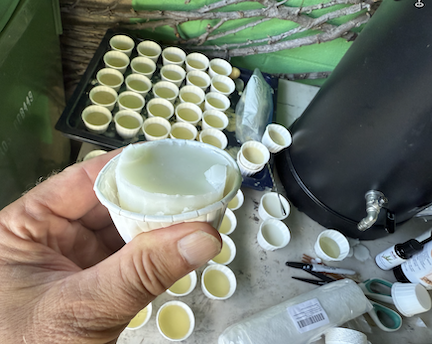
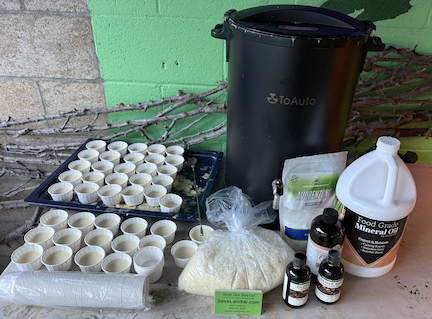
About 10-20 wax cups are needed per tree, depending on their type and "frondiness". The wax will not fall out of the tree, and will continue emitting essential oils for months, make those entry point unpalatable to CRB.
Once CRB infests a tree, we have found that it CAN be rescued in many cases by adding protective measures immediately. This prevents the CRB from making nightly return trips to munch deeper into the heart of the palm.
Bowtie Nets
Research conducted in India, plus real-world experience in Hawaii, indicates the effectiveness of netting trees to keep CRB out of the crowns of trees. Netting must be regularly adjusted or renewed due to the growth of the trees. The type of netting and how it is deployed is extremely important. If wrapped too tight, the beetle can eat right through it. The best netting is 1" diagonal nylon fishing net, wrapped relatively loosely, that the beetles get stuck in trying to go through one of the holes in the netting, causing them to die. One source of netting is Memphis Net & Twine. Select netting with these specifications: 1/2" SQ., 1" STR., 110 MD which means each hole is 1/2" square but diagonally it's 1" when stretched. This is the perfect size as the beetles will try to squeeze through the holes and get stuck.The current preferred method is the utilization of "bowtie" nets. This involves tieing small sheets of netting around small rocks (~2") and form "bow ties" of netting by knotting the netting in a particular fashion. These are then put in the frond creviceswhere the CRB normally enters. This approach, from the University of Guam, is documented in this Youtube Video on the Bow Tie Trap.
What About Injecting My Trees with Insecticide?
Several companies offer the service of injecting the trunks of your trees with insecticide. The insecticide is drawn up through the entire tree. When a CRB feeds on the heart of the palm, it ingests the poison and becomes paralyzed and may eventually die in place or may fly away and probably die elsewhere, depending on the dose. Tree injections must be repeated every 6 months or so to remain effective.
Note that the poison does not repel the CRB from eating the heart of the palm. The tree is still damaged until that beetle dies, but other CRB may cause additional damage to the same tree. This is why we recommend protecting trees with essential oils embedded in wax and bowtie nets: they repel CRB from taking their first bite, and protect damaged trees from additional damage.
Tree injections have been used by the Honolulu Parks Department to save some of the coconut trees in urban Honolulu. It costs about $150-$300/tree. Tree injections are also being used on MidPac Golf Course where they have injected all of their 260+ palm trees with imidacloprid.
Save Lanikai does not recommend Lanikai residents injecting trees except in special circumstances for the following reasons:
- Injections do not prevent CRB from eating your palms, but poison them if they do; however other CRB can cause additional damage.
- Other effective means (see above) are available to prevent CRB from damaging your palms.
- The insecticides poison bees and other pollinators because the poison is in every part of the tree, including emergying flowers. The only way to prevent such poisoning is to trim trees on a very short interval (1-2 months) without fail to remove flowers before they even emerge. This is unrealistic for most residents due to the expense of frequent trimming.
- Coconuts, if allowed to form, are poisonous to humans (this has happened on Oahu).
- It won't "cure" trees that have been infested: the beetle galleries already carved into the crown tissue remain; the insecticide does not heal or expel that existing tunneling, so symptoms are reduced but do not disappear and treated trees still carry the old bore holes.
- Recommendation: Use other effective methods first to avoid the negative environmental impacts of these powerful insecticides.
Other Methods for Contolling CRB
- Ring Spray System. Recently developed by Oahu resident Brown Cannon Jr., this is a device mounted in the crown of each tree with a tube running down the trunk of the tree to the ground where it is hooked to a pump. Trees are periodically sprayed with a mixture containing basil oil, which UH has found is an excellent deterrent to CRB. Do-it-yourself instructions are included at the web site SaveHawaiianPalms.com. There's also great instructions on this website for building CRB traps.
- Regularly spraying the crown of the tree with insecticide. This is effective according to the Hawaii Invasive Species Council. Save Lanikai does not recommend this approach becuase of its adverse impact on pollinators, and because most insecticides will evaporate within a week or two, rendering the tree susceptible to CRB once again. Recommendation: Use other effective methods first to avoid the negative environmental impacts of these powerful insecticides.
- Spraying the crown of the tree with natural oils. Testing by Hawaii Invasive Species Council has shown that Neem oil is NOT very effective. However, Basil oil is effective as a repellant. In tests showing its effectiveness, Basil oil was applied every 3 weeks. Good info on Basil oil can be found at CRB Management Options for Landscape and Nurseries in Hawaii. Basil oil can also be incorporated into "frond inserts" as described above. Note, however, that essential oils will evaporate rapidly unless sprayed into the crowns every week or so. This may work for short trees or trees in which you can get a spray up to the crowns, but isn't viable for tall trees.
- Moth balls. Research from India has shown the moth balls (Naphthalene) are effective at repelling CRB. The researchers worked with relatively young trees (3.5 years old) and simply put the mothballs between the fronds and renewed them every 45 days. They compared the moth balls with insecticide and found the moth balls worked better. In Hawaii, real world experience has shown that moth balls (about half inch in diameter) dissolve within a couple weeks, so are no longer recommended. [Maybe they have larger moth balls in India.] Frond inserts (described above) using essential oils are a better bet as they are designed to withstand the elements and continue to emit CRB-repulsive odors for months.
Ideal Protective Practice for Coconut Trees
- Avoid insecticides as they are toxic to honey bees and other pollinators, which we need
- Trim tree of all flowers and nuts.
- Apply one or more of:
- Frond inserts as described above
- "Bow Tie" nets as described above
- Spray the fungi Metarhizium anisopliae on all decaying vegetable matter every month
- Monitor, renew, and retrim every 1-3 months
- Remove mulch piles or spray mulch with Metarhizium anisopliae
Biocontrols, the final solution
- In other parts of the Pacific, a virus, toxic to CRB, has been used to contain CRB.
- The strain of CRB in Hawaii, which came from Guam and is designated as CRB-G, developed resistance to the virus.
- UH is experimenting and running tests to see if a new virus can be developed and tested to make sure it does not harm any native beetle species here. This will take years, but will likely be successful.
- More promising still is a naturally occurring fungi called Metarhizium anisopliae which kills CRB in 3-10 days through infection and internal proliferation (not by "poisoning" per se). This fungi attacks both larval stages and adults and can be applied to mulch piles. It is already "in the wild" in Hawaii, and has been studied in Hawaii and proven effective. It is not widely used because it is not "registered" in the State of Hawaii. However, anyone can buy Metarhizium anisopliae online and apply it at will.
See this paper on Metarhizium anisopliae: Biological Insecticides for CRB in Hawaii
- Until biocontrol agents become widely dispersed in Hawaii's ecosystem, protecting individual trees, using the measures described above, AND managing CRB breeding areas like mulch piles, are the best short-term strategies.
Tree Trimmers Who Can Help
Here is contact information for tree trimmers who can help deploy protective measures for your trees. Tree trimmers, please contact us to get on this list. Save Lanikai is providing, for Lanikai residents, free wax cups and bowtie nets that these trimmers will deploy in the crowns of your trees.
- Oahu Green (Miguel & Eli):
Miguel: 808-343-8063 Text or Call
Eli: 808-497-0272 Text or Call
Email:Oahugreen@gmail.com - Hele Mai Landscape and Tree Service (Jason & Dana):
Jason: 808-291-2429 Text or Call
Dana: 808-753-3297 Text or Call
Email:helemai@outlook.com - Tukula Trees, Inc. (Keith & Baron):
808-807-4432 Text or Call
Web: Tukulatrees.com
Email:contact@tukulatrees.com - Starfarm Conservation Inc. (Mike & Frank):
808-342-4228 Text or Call
Web: Starfarmshawaii.com
Email:starfarmshawaii@gmail.com